












11/12/2010
LIVRE Méthodes constructives pour la géométrie spatiale

21:46 Publié dans Livres, Méthodes constructives pour la géométrie spatiale | Lien permanent | Commentaires (0) |  |
|  del.icio.us |
  |
|  Digg |
  Facebook
LIVRE Géométrie descriptive

21:44 Publié dans Géométrie descriptive, Livres | Lien permanent | Commentaires (0) | | del.icio.us | | Digg | Facebook
LIVRE Les démonstrations et les algorithmes

21:42 Publié dans Les démonstrations et les algorithmes, Livres | Lien permanent | Commentaires (0) | | del.icio.us | | Digg | Facebook
LIVRE Statistiques avec R

|
|
21:40 Publié dans Statistiques avec R | Lien permanent | Commentaires (0) | | del.icio.us | | Digg | Facebook
Théorie analytique des nombres
La théorie analytique des nombres est la branche de la théorie des nombres qui utilise les méthodes de l'analyse mathématique. Son premier succès majeur fut l'application de l'analyse par Dirichlet pour la démonstration du Théorème de Dirichlet (existence d'une infinité de nombres premiers dans toute progression arithmétique an+b, lorsque a et b sont des entiers premiers entre eux). Les démonstrations du théorème des nombres premiers basées sur la fonction zêta de Riemann représentent une autre étape. Le développement des ramifications de la discipline, reste similaire à celui de la discipline qui fut à son apogée dans les années 1930. La théorie multiplicative des nombres traite de la distribution des nombres premiers, utilisant les séries de Dirichlet comme fonctions génératrices. Il est supposé que les méthodes s'appliqueront finalement aux fonctions L générales, bien que cette théorie soit encore largement hypothétique. La théorie additive des nombres concerne les problèmes typiques comme la conjecture de Goldbach ou le problème de Waring. Les méthodes ont quelque peu évolué. La méthode du cercle de Hardy et Littlewood avait été conçue comme appliquant aux séries entières près du cercle unité dans le plan complexe ; on y pense désormais en termes de somme exponentielle limitée (c'est-à-dire, sur le cercle unité, mais avec les séries entières tronquées). Les besoins de l'approximation diophantiennesont pour les fonctions auxiliaires qui ne sont pas des fonctions génératrices - leurs coefficients sont construits par l'utilisation d'un principe du casier - et impliquent plusieurs variables complexes. Les champs de l'approximation diophantienne et la théorie transcendantale ont pris de l'expansion, au point que les techniques ont été appliquées à la Conjecture de Mordell. Le plus grand changement technique unique après 1950 fut le développement des méthodes du crible comme un outil auxiliaire, particulièrement dans les problèmes multiplicatifs. Elles sont combinatoires par nature, et plutôt variées. Les utilisations de la théorie probabiliste des nombres sont aussi souvent citées - formes d'assertions de distributions aléatoires sur les nombres premiers, par exemple. Celles-ci n'ont pas reçu une forme définitive. La branche extrême de la théorie combinatoire a en retour été très influencée par la valeur placée dans la théorie analytique des nombres sur des limites quantitatives supérieures et inférieures.Théorie analytique des nombres


21:31 Publié dans Théorie analytique des nombres | Lien permanent | Commentaires (0) | | del.icio.us | | Digg | Facebook
Vladimir Vapnik
Vladimir Vapnik
 |
Cet article est une ébauche concernant un mathématicien.
Vous pouvez partager vos connaissances en l’améliorant (comment ?) selon les recommandations des projets correspondants.
|
Vladimir Naumovich Vapnik est l'un des principaux contributeurs à la théorie de Vapnik-Chervonenkis. En 1995 il est nommé professeur d'informatique et de statistiques au Royal Holloway College, à l'Université de Londres. Aux laboratoires Bell d'AT&T de 1991 à 2001?, Vladimir Vapnik et ses collègues développent la théorie des machines à support vectoriel (aussi appelées "machines à vecteurs de support", ou encore "séparateurs à vaste marge"), dont ils démontrent l'intérêt dans nombre des problèmatiques importantes de l'apprentissage des machines et des réseaux de neurones, tels que la reconnaissance de caractères. Il travaille désormais aux laboratoires NEC de Princeton, dans le New Jersey, aux États-Unis, ainsi qu'à l'université Columbia, à New York. En 2006, Vladimir Vapnik est admis à l'Académie Nationale d'Ingénierie des Etats-Unis.
Né en Union Soviétique, il obtient en 1958 un mastère de mathématiques à l'Université d'État d'Ouzbékistan, à Samarkand, en Ouzbékistan, puis obtient en 1964 un doctorat destatistiques à l'Institut des Sciences de Contrôle, à Moscou. Il travaille dans ce même institut de 1961 à 1990, et en devient le directeur du département de recherche en informatique.
Sommaire[masquer] |
Bibliographie [modifier]
Liens internes [modifier]
Liens externes [modifier]
Sources [modifier]


21:29 Publié dans Vladimir Vapnik | Lien permanent | Commentaires (0) | | del.icio.us | | Digg | Facebook
Théorème de Rao-Blackwell
Le théorème de Rao-Blackwell permet à partir d'un estimateur (statistique) de construire un estimateur plus précis grâce à l'usage d'une statistique exhaustive. L'avantage de ce théorème est que l'estimateur initial n'a pas nécessairement besoin d'être très bon pour que l'estimateur que ce théorème construit fournisse de bons résultats. Il suffit en effet que l'estimateur de départ soit sans biais pour pouvoir construire un nouvel estimateur. L'estimateur de départ n'a entre autres pas besoin d'être convergent ou efficace.Théorème de Rao-Blackwell
Sommaire[masquer] |
Si δ est un estimateur sans biais et S une statistique exhaustive alors l'estimateur augmenté Dans le cas multiparamétrique où l'estimateur et le paramètre sont en dimensions plus grands que 1 on remplace la variance par la matrice de variance-covariance. Le théorème de Rao-Blackwell donne alors: Quel que soit A défini positif l'erreur quadratique en utilisant le produit scalaire défini par A est toujours plus faible pour l'estimateur augmenté que pour l'estimateur initial. Le fait de pouvoir prendre n'importe quel produit scalaire et non seulement le produit scalaire usuel peut être très utile pour que les différentes composantes ne soit pas normés de la même façon. Ceci peut par exemple être le cas quand si une erreur sur l'une ou l'autre des composantes "coute plus cher" on pourra choisir une matrice de produit scalaire en fonction. L'estimateur augmenté sera toujours préférable même avec ce produit scalaire non usuel. En fait le théorème de Rao Blackwell donne légèrement plus vu qu'il dit que quelle que soit la fonction de perte convexe L On considère donc n variables aléatoires Xi iid distribués selon des lois de Poisson de paramètre λ et l'on cherche à estimer e − λ. On peut montrer assez facilement en considérant lecritère de factorisation que On peut montrer que: δ1 est tout comme δ0 un estimateur de e − λ mais a l'avantage d'être beaucoup plus précis grâce à l'application du théorème de Rao–Blackwell. On peut montrer que En fait bien que Théorème [modifier]
 à une variance plus faible que la variance de l'estimateur initial. L'estimateur augmenté est donc toujours plus précis que l'estimateur initial si on l'augmente d'une statistique exhaustive.
 . L'estimateur augmenté est donc toujours plus précis et ce quelle que soit la définition (raisonnable) que l'on donne à "précis".
Exemple [modifier]
 est une statistique exhaustive. Pour montrer l'intérêt de ce théorème on prend un estimateur grossier de e − λ: δ0 = δ(X1,0) qui vaut 1 si X1 = 0 et 0 sinon. Cet estimateur ne prend en compte qu'une seule valeur de X alors qu'on en dispose de n et il ne donne pour résultat que 0 ou 1 alors que la valeur de e − λ appartient à l'intervalle ]0,1] et ne vaut sans doute pas 1. (si c'était le cas Xi vaudrait 0 de façon déterministe et on s'en serai aperçu en regardant les données). Pourtant bien que cet estimateur soit très grossier l'estimateur augmenté obtenu est très bon et on peut même montrer qu'il est optimal. L'estimateur augmenté vaut:

 est un estimateur optimal de λ (Voir Théorème de Lehman Scheffé) mais que l'estimateur optimal pour e − λ est différent de
  . soit un estimateur convergent de e − λ c'est un estimateur de relativement mauvaise qualité car il est biaisé et qu'en l'estimant de la sorte on fait une erreur systématique sur l'estimation. De façon général il peut être intéressant pour estimer f(λ) de construire un estimateur spécifique plutôt que de calculer la valeur prise par f par l'estimateur de λ.
voir aussi [modifier]
Références [modifier]
Liens externes [modifier]

21:28 Publié dans Théorème de Rao-Blackwell | Lien permanent | Commentaires (0) | | del.icio.us | | Digg | Facebook
Mathematics Genealogy Project
146634 records as of 11 December 2010 20 October 2010—Today we have made an additional feature available to improve the display of mathematics in dissertation titles. We now support standard LaTeX code to be displayed using the MathJax package. Please enclose any LaTeX code in submissions between dollar signs ($) to ensure the smoothest implementation of this. To see an example of a thesis title rendered using MathJax, see the page for James Angelos. 20 October 2010—We recently experienced difficulties with our server that may have resulted in data submissions made between 9 October 2010 and 18 October 2010 not having been received. If you submitted new data or data updates in that period, we encourage you to resubmit them to ensure they are published in a timely manner. Announcements are archived on the news page.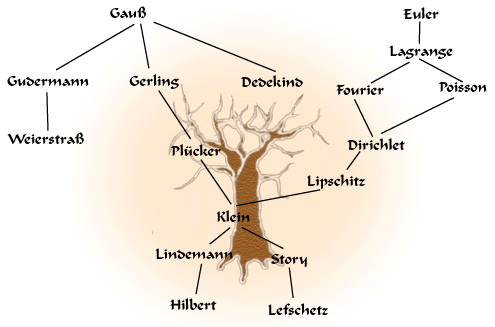
View the growth of the genealogy projectNews
21:26 Publié dans Mathematics Genealogy Project | Lien permanent | Commentaires (0) | | del.icio.us | | Digg | Facebook
Calyampudi Radhakrishna Rao
Calyampudi Radhakrishna Rao
|
|
Cet article est une ébauche concernant un mathématicien.
Vous pouvez partager vos connaissances en l’améliorant (comment ?) selon les recommandations des projets correspondants.
|
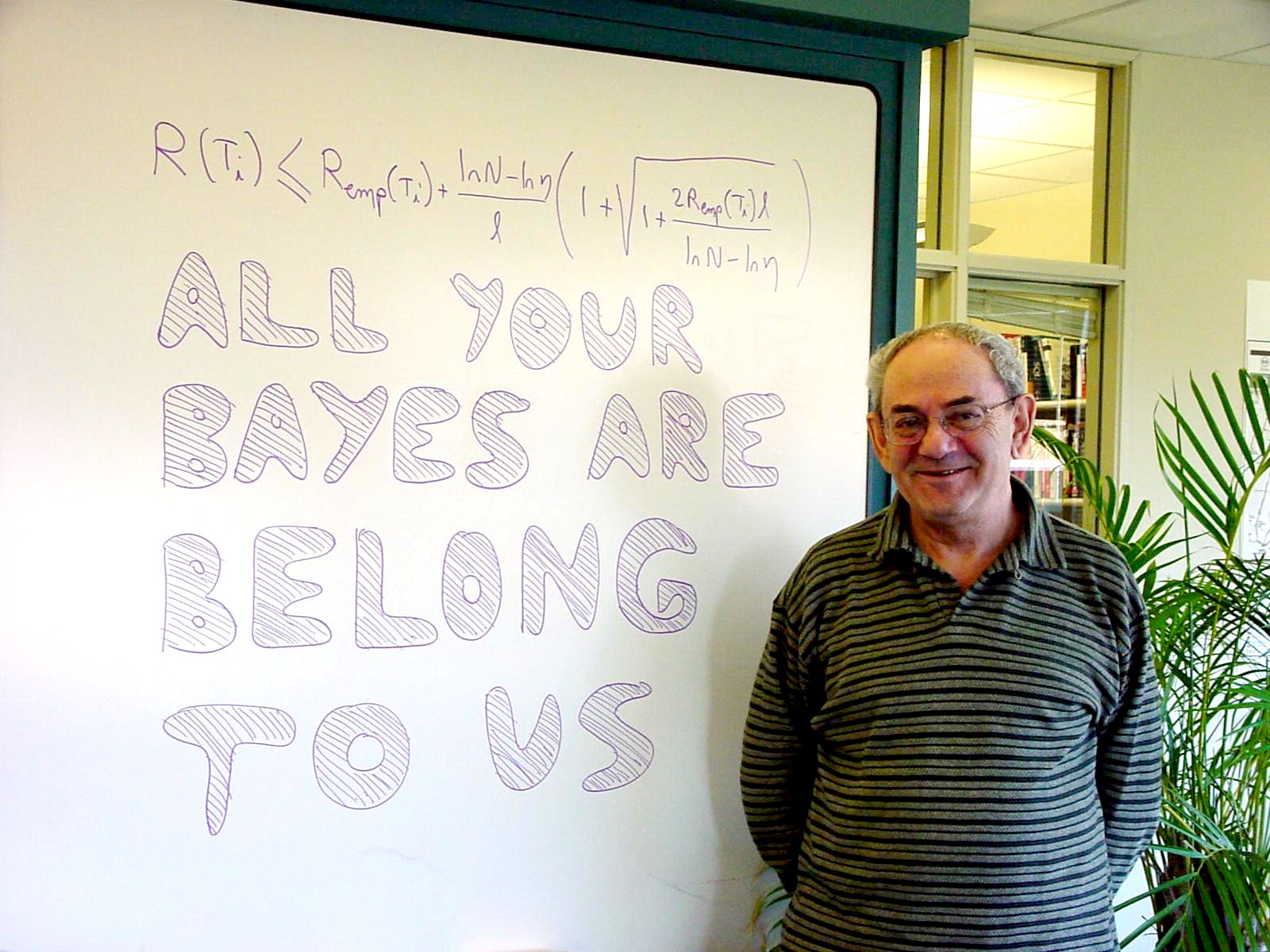
Calyampudi Radhakrishna Rao est un célèbre statisticien indien, né en septembre 1920. Il est actuellement professeur émérite à l'Université de Penn. Il est né à Hadagali dans l'État de Karnataka. Il possède une maîtrise en mathématiques de l'Université Andhra, et une maîtrise en statiques de l'Université de Calcutta reçue en 1943. Rao a travaillé à l'Institut indien de statistiques (ISI) et au Museum of Anthropology de Cambridge avant d'obtenir un doctorat au King's College (Cambridge) sous la direction de Ronald Aylmer Fisher en 1948. Parmi ses découvertes les plus célèbres, on lui doit la borne de Cramér-Rao (connue sous le nom de borne FDCR, ou inégalité de Rao-Cramér), et le Théorème de Rao-Blackwell relatant tous deux la qualité des estimateurs. Parmi les autres domaines dans lesquels il a travaillé, on peut citer l'analyse vectorielle et la géométrie différentielle. Rao est lauréat de la médaille Wilks (en) ; membre de huit Académies nationales d'Inde, du Royaume-Uni, des États-Unis et d'Italie, il a reçu une douzaine de prix, médailles, et autres récompenses pour ses contributions en statistiques et en science plus généralement. Rao a été récompensé par la National Medal of Science des États-Unis, la plus haute distinction américaine pour l'ensemble de ses travaux dans le domaine de la recherche scientifique en juin 2002.
Sommaire[masquer] |
(en) M. H. DeGroot A Conversation with C.R. Rao, Statistical Science, 2 (1987), 53-67.Référence [modifier]
Voir aussi [modifier]
Articles connexes [modifier]
Liens externes [modifier]

21:25 Publié dans Calyampudi Radhakrishna Rao, Mathématiciens | Lien permanent | Commentaires (0) | | del.icio.us | | Digg | Facebook
A history of Zero
A history of Zero
| Ancient Indian Mathematics index | History Topics Index |
One of the commonest questions which the readers of this archive ask is: Who discovered zero? Why then have we not written an article on zero as one of the first in the archive? The reason is basically because of the difficulty of answering the question in a satisfactory form. If someone had come up with the concept of zero which everyone then saw as a brilliant innovation to enter mathematics from that time on, the question would have a satisfactory answer even if we did not know which genius invented it. The historical record, however, shows quite a different path towards the concept. Zero makes shadowy appearances only to vanish again almost as if mathematicians were searching for it yet did not recognise its fundamental significance even when they saw it.
The first thing to say about zero is that there are two uses of zero which are both extremely important but are somewhat different. One use is as an empty place indicator in our place-value number system. Hence in a number like 2106 the zero is used so that the positions of the 2 and 1 are correct. Clearly 216 means something quite different. The second use of zero is as a number itself in the form we use it as 0. There are also different aspects of zero within these two uses, namely the concept, the notation, and the name. (Our name "zero" derives ultimately from the Arabic sifr which also gives us the word "cipher".)
Neither of the above uses has an easily described history. It just did not happen that someone invented the ideas, and then everyone started to use them. Also it is fair to say that the number zero is far from an intuitive concept. Mathematical problems started as 'real' problems rather than abstract problems. Numbers in early historical times were thought of much more concretely than the abstract concepts which are our numbers today. There are giant mental leaps from 5 horses to 5 "things" and then to the abstract idea of "five". If ancient peoples solved a problem about how many horses a farmer needed then the problem was not going to have 0 or -23 as an answer.
One might think that once a place-value number system came into existence then the 0 as an empty place indicator is a necessary idea, yet the Babylonians had a place-value number system without this feature for over 1000 years. Moreover there is absolutely no evidence that the Babylonians felt that there was any problem with the ambiguity which existed. Remarkably, original texts survive from the era of Babylonian mathematics. The Babylonians wrote on tablets of unbaked clay, using cuneiform writing. The symbols were pressed into soft clay tablets with the slanted edge of a stylus and so had a wedge-shaped appearance (and hence the name cuneiform). Many tablets from around 1700 BC survive and we can read the original texts. Of course their notation for numbers was quite different from ours (and not based on 10 but on 60) but to translate into our notation they would not distinguish between 2106 and 216 (the context would have to show which was intended). It was not until around 400 BC that the Babylonians put two wedge symbols into the place where we would put zero to indicate which was meant, 216 or 21 '' 6.
The two wedges were not the only notation used, however, and on a tablet found at Kish, an ancient Mesopotamian city located east of Babylon in what is today south-central Iraq, a different notation is used. This tablet, thought to date from around 700 BC, uses three hooks to denote an empty place in the positional notation. Other tablets dated from around the same time use a single hook for an empty place. There is one common feature to this use of different marks to denote an empty position. This is the fact that it never occured at the end of the digits but always between two digits. So although we find 21 '' 6 we never find 216 ''. One has to assume that the older feeling that the context was sufficient to indicate which was intended still applied in these cases.
If this reference to context appears silly then it is worth noting that we still use context to interpret numbers today. If I take a bus to a nearby town and ask what the fare is then I know that the answer "It's three fifty" means three pounds fifty pence. Yet if the same answer is given to the question about the cost of a flight from Edinburgh to New York then I know that three hundred and fifty pounds is what is intended.
We can see from this that the early use of zero to denote an empty place is not really the use of zero as a number at all, merely the use of some type of punctuation mark so that the numbers had the correct interpretation.
Now the ancient Greeks began their contributions to mathematics around the time that zero as an empty place indicator was coming into use in Babylonian mathematics. The Greeks however did not adopt a positional number system. It is worth thinking just how significant this fact is. How could the brilliant mathematical advances of the Greeks not see them adopt a number system with all the advantages that the Babylonian place-value system possessed? The real answer to this question is more subtle than the simple answer that we are about to give, but basically the Greek mathematical achievements were based on geometry. Although Euclid's Elements contains a book on number theory, it is based on geometry. In other words Greek mathematicians did not need to name their numbers since they worked with numbers as lengths of lines. Numbers which required to be named for records were used by merchants, not mathematicians, and hence no clever notation was needed.
Now there were exceptions to what we have just stated. The exceptions were the mathematicians who were involved in recording astronomical data. Here we find the first use of the symbol which we recognise today as the notation for zero, for Greek astronomers began to use the symbol O. There are many theories why this particular notation was used. Some historians favour the explanation that it is omicron, the first letter of the Greek word for nothing namely "ouden". Neugebauer, however, dismisses this explanation since the Greeks already used omicron as a number - it represented 70 (the Greek number system was based on their alphabet). Other explanations offered include the fact that it stands for "obol", a coin of almost no value, and that it arises when counters were used for counting on a sand board. The suggestion here is that when a counter was removed to leave an empty column it left a depression in the sand which looked like O.
Ptolemy in the Almagest written around 130 AD uses the Babylonian sexagesimal system together with the empty place holder O. By this time Ptolemy is using the symbol both between digits and at the end of a number and one might be tempted to believe that at least zero as an empty place holder had firmly arrived. This, however, is far from what happened. Only a few exceptional astronomers used the notation and it would fall out of use several more times before finally establishing itself. The idea of the zero place (certainly not thought of as a number by Ptolemy who still considered it as a sort of punctuation mark) makes its next appearance in Indian mathematics.
The scene now moves to India where it is fair to say the numerals and number system was born which have evolved into the highly sophisticated ones we use today. Of course that is not to say that the Indian system did not owe something to earlier systems and many historians of mathematics believe that the Indian use of zero evolved from its use by Greek astronomers. As well as some historians who seem to want to play down the contribution of the Indians in a most unreasonable way, there are also those who make claims about the Indian invention of zero which seem to go far too far. For example Mukherjee in [6] claims:-
... the mathematical conception of zero ... was also present in the spiritual form from 17 000 years back in India.
What is certain is that by around 650AD the use of zero as a number came into Indian mathematics. The Indians also used a place-value system and zero was used to denote an empty place. In fact there is evidence of an empty place holder in positional numbers from as early as 200AD in India but some historians dismiss these as later forgeries. Let us examine this latter use first since it continues the development described above.
In around 500AD Aryabhata devised a number system which has no zero yet was a positional system. He used the word "kha" for position and it would be used later as the name for zero. There is evidence that a dot had been used in earlier Indian manuscripts to denote an empty place in positional notation. It is interesting that the same documents sometimes also used a dot to denote an unknown where we might use x. Later Indian mathematicians had names for zero in positional numbers yet had no symbol for it. The first record of the Indian use of zero which is dated and agreed by all to be genuine was written in 876.
We have an inscription on a stone tablet which contains a date which translates to 876. The inscription concerns the town of Gwalior, 400 km south of Delhi, where they planted a garden 187 by 270 hastas which would produce enough flowers to allow 50 garlands per day to be given to the local temple. Both of the numbers 270 and 50 are denoted almost as they appear today although the 0 is smaller and slightly raised.
We now come to considering the first appearance of zero as a number. Let us first note that it is not in any sense a natural candidate for a number. From early times numbers are words which refer to collections of objects. Certainly the idea of number became more and more abstract and this abstraction then makes possible the consideration of zero and negative numbers which do not arise as properties of collections of objects. Of course the problem which arises when one tries to consider zero and negatives as numbers is how they interact in regard to the operations of arithmetic, addition, subtraction, multiplication and division. In three important books the Indian mathematicians Brahmagupta, Mahavira and Bhaskara tried to answer these questions.
Brahmagupta attempted to give the rules for arithmetic involving zero and negative numbers in the seventh century. He explained that given a number then if you subtract it from itself you obtain zero. He gave the following rules for addition which involve zero:-
The sum of zero and a negative number is negative, the sum of a positive number and zero is positive, the sum of zero and zero is zero.
Subtraction is a little harder:-
A negative number subtracted from zero is positive, a positive number subtracted from zero is negative, zero subtracted from a negative number is negative, zero subtracted from a positive number is positive, zero subtracted from zero is zero.
Brahmagupta then says that any number when multiplied by zero is zero but struggles when it comes to division:-
A positive or negative number when divided by zero is a fraction with the zero as denominator. Zero divided by a negative or positive number is either zero or is expressed as a fraction with zero as numerator and the finite quantity as denominator. Zero divided by zero is zero.
Really Brahmagupta is saying very little when he suggests that n divided by zero is n/0. Clearly he is struggling here. He is certainly wrong when he then claims that zero divided by zero is zero. However it is a brilliant attempt from the first person that we know who tried to extend arithmetic to negative numbers and zero.
In 830, around 200 years after Brahmagupta wrote his masterpiece, Mahavira wrote Ganita Sara Samgraha which was designed as an updating of Brahmagupta's book. He correctly states that:-
... a number multiplied by zero is zero, and a number remains the same when zero is subtracted from it.
However his attempts to improve on Brahmagupta's statements on dividing by zero seem to lead him into error. He writes:-
A number remains unchanged when divided by zero.
Since this is clearly incorrect my use of the words "seem to lead him into error" might be seen as confusing. The reason for this phrase is that some commentators on Mahavira have tried to find excuses for his incorrect statement.
Bhaskara wrote over 500 years after Brahmagupta. Despite the passage of time he is still struggling to explain division by zero. He writes:-
A quantity divided by zero becomes a fraction the denominator of which is zero. This fraction is termed an infinite quantity. In this quantity consisting of that which has zero for its divisor, there is no alteration, though many may be inserted or extracted; as no change takes place in the infinite and immutable God when worlds are created or destroyed, though numerous orders of beings are absorbed or put forth.
So Bhaskara tried to solve the problem by writing n/0 = ∞. At first sight we might be tempted to believe that Bhaskara has it correct, but of course he does not. If this were true then 0 times ∞ must be equal to every number n, so all numbers are equal. The Indian mathematicians could not bring themselves to the point of admitting that one could not divide by zero. Bhaskara did correctly state other properties of zero, however, such as 02 = 0, and √0 = 0.
Perhaps we should note at this point that there was another civilisation which developed a place-value number system with a zero. This was the Maya people who lived in central America, occupying the area which today is southern Mexico, Guatemala, and northern Belize. This was an old civilisation but flourished particularly between 250 and 900. We know that by 665 they used a place-value number system to base 20 with a symbol for zero. However their use of zero goes back further than this and was in use before they introduced the place-valued number system. This is a remarkable achievement but sadly did not influence other peoples.
You can see a separate article about Mayan mathematics.
The brilliant work of the Indian mathematicians was transmitted to the Islamic and Arabic mathematicians further west. It came at an early stage for al-Khwarizmi wrote Al'Khwarizmi on the Hindu Art of Reckoning which describes the Indian place-value system of numerals based on 1, 2, 3, 4, 5, 6, 7, 8, 9, and 0. This work was the first in what is now Iraq to use zero as a place holder in positional base notation. Ibn Ezra, in the 12th century, wrote three treatises on numbers which helped to bring the Indian symbols and ideas of decimal fractions to the attention of some of the learned people in Europe. The Book of the Number describes the decimal system for integers with place values from left to right. In this work ibn Ezra uses zero which he calls galgal (meaning wheel or circle). Slightly later in the 12thcentury al-Samawal was writing:-
If we subtract a positive number from zero the same negative number remains. ... if we subtract a negative number from zero the same positive number remains.
The Indian ideas spread east to China as well as west to the Islamic countries. In 1247 the Chinese mathematician Ch'in Chiu-Shao wrote Mathematical treatise in nine sections which uses the symbol O for zero. A little later, in 1303, Zhu Shijie wrote Jade mirror of the four elements which again uses the symbol O for zero.
Fibonacci was one of the main people to bring these new ideas about the number system to Europe. As the authors of [12] write:-
An important link between the Hindu-Arabic number system and the European mathematics is the Italian mathematician Fibonacci.
In Liber Abaci he described the nine Indian symbols together with the sign 0 for Europeans in around 1200 but it was not widely used for a long time after that. It is significant that Fibonacci is not bold enough to treat 0 in the same way as the other numbers 1, 2, 3, 4, 5, 6, 7, 8, 9 since he speaks of the "sign" zero while the other symbols he speaks of as numbers. Although clearly bringing the Indian numerals to Europe was of major importance we can see that in his treatment of zero he did not reach the sophistication of the Indians Brahmagupta, Mahavira and Bhaskara nor of the Arabic and Islamic mathematicians such as al-Samawal.
One might have thought that the progress of the number systems in general, and zero in particular, would have been steady from this time on. However, this was far from the case. Cardan solved cubic and quartic equations without using zero. He would have found his work in the 1500's so much easier if he had had a zero but it was not part of his mathematics. By the 1600's zero began to come into widespread use but still only after encountering a lot of resistance.
Of course there are still signs of the problems caused by zero. Recently many people throughout the world celebrated the new millennium on 1 January 2000. Of course they celebrated the passing of only 1999 years since when the calendar was set up no year zero was specified. Although one might forgive the original error, it is a little surprising that most people seemed unable to understand why the third millennium and the 21st century begin on 1 January 2001. Zero is still causing problems!
References (14 books/articles)
Other Web sites:
Astroseti (A Spanish translation of this article)
Article by: J J O'Connor and E F Robertson
JOC/EFR November 2000
The URL of this page is:
http://www-history.mcs.st-andrews.ac.uk/HistTopics/Zero.html
Source : http://www-groups.dcs.st-and.ac.uk/~history/HistTopics/Ze...
12:03 Publié dans A history of Zero | Lien permanent | Commentaires (0) | | del.icio.us | | Digg | Facebook