













04/12/2010
Mathematica
Mathematica
| Mathematica | |
 |
|
| Développeur | Wolfram Research |
|---|---|
| Dernière version | 7 (18 novembre 2008) [+/−] |
| Environnements | Multiplate-forme (liste détaillée) |
| Type | Logiciel de calcul formel |
| Licence | Propriétaire |
| Site Web | Page d'accueil de Mathematica |
modifier  |
|
Mathematica est un logiciel propriétaire de calcul formel édité par Wolfram Research, la société de Stephen Wolfram. Wolfram commence à travailler sur le logiciel en 1986 et en sort la première version en 1988. Il est disponible sur de nombreuses plateformes et supporte un large choix d'opérations. Le système de Mathematica est formé d'un noyau, qui réalise les calculs et peut être exécuté sur une autre machine que celle de l'utilisateur, et d'une interface interactive pour entrer les données. Celle-ci attend des entrées de l'utilisateur exprimées dans le langage de Mathematica, selon une syntaxe définie, et affiche le résultat des calculs sous forme de texte simple, de formules, ou d'images. En France et en Suisse, le logiciel est avec Maple présent dans l'enseignement supérieur. L'entreprise a mis en service en site internet dit intelligent, basé entre autres sur Mathematica: Wolfram|Alpha. Il est ainsi possible d'utiliser les ressources de Mathematica gratuitement.Voir aussi [modifier]
Articles connexes [modifier]
Liens externes [modifier]


07:54 Publié dans Mathematica | Lien permanent | Commentaires (1) |  |
|  del.icio.us |
  |
|  Digg |
  Facebook
Randomness and Recurrence in Dynamical Systems
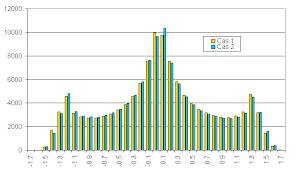
Double-Click Image to Enlarge Catalog Code: CAM-31 This book, part of the MAA's oldest book series, makes the ideas of randomness and recurrence in dynamical systems comprehensible for undergraduates and beginning graduate students. It fills the gap between undergraduate teaching and current mathematical research, bringing out relevant results with a minimum of measure theory. Author Rodney Nillsen develops new techniques of proof and adapts known proofs to make the material accessible to students with a background only in elementary analysis. Forward Index of Symbols The curious phenomenon of the leading significant digit (p. 180): Suppose we have a collection of positive numbers, perhaps arising from a set of data. Assuming the data is random, we might expect that the leading digits of the numbers in the data would occur with an approximately equal frequency. So, it may come as a very surprising fact that this is often not the case. Back in the days when electronic calculators did not exist, arithmetical calculations were carried out using books of logarithmic tables. It seems to have been Simon Newcomb, the professor of mathematics and astronomy at Johns Hopkins University, who observed in 1881 that the pages near the front of books of logarithms were more used than the pages towards the back. He wrote: "That the ten digits do not occur with equal frequency must be evident to any one making use of logarithmic tables, and noticing how much faster the first pages wear out than the last ones. The first significant digit is oftener 1 than any other digit, and the frequency diminishes up to 9." Rodney Nillsen (University of Wollongong, in New South Wales, Australia) received his undergraduate education at the University of Tasmania and postgraduate education at Flinders University of South Australia. A member of the MAA, he is interested in harmonic analysis, functional analysis, differential equations, and measure theory. He is the author of Differential Spaces and Invariant Linear Forms (1994). Source : http://www.maa.org/pubs/CAM-31.html
Randomness and Recurrence in Dynamical Systems
Rodney Nillsen
ISBN: 978-0-88385-043-5
357 pp., Hardbound, 2010
List Price: $52.95
Member Price: $42.95
Series: Carus Mathematical Monographs, #31
• Emphasizes interpretations of results, concepts, and connections to other areas of inquiry;
• Includes exercises, investigations, and more than 60 figures to explain proofs;
• Sets the mathematical ideas in historical context;
• Suggests areas for further study.
Table of Contents
Preface
Background Ideas and Knowledge
Irrational Numbers and Dynamical Systems
Probability and Randomness
Recurrence
Averaging in Time and Space
Index of Subjects
Excerpt
About the Author
07:53 Publié dans Randomness and Recurrence in Dynamical Systems | Lien permanent | Commentaires (0) | | del.icio.us | | Digg | Facebook
Calculus: Modeling and Application, 2nd Edition
Calculus: Modeling and Application, 2nd Edition, by David A. Smith and Lawrence C. Moore of Duke University, responds to advances in technology that permit the integration of text and student activities into a unified whole. In this approach, students can use mathematics to structure their understanding of and investigate questions in the world around them, to formulate problems and find solutions, then to communicate their results to others. This interactive textbook covers two semesters of single-variable calculus. Its features include use of real-world contexts for motivation, guided discovery learning, hands-on activities (including built-in applets), a problem-solving orientation, encouragement of teamwork, written responses to questions, tools for self-checking of results, intelligent use of technology, and high expectation of students. Calculus: Modeling and Application is available through License Agreement subscription. Schools that adopt the text will be charged each semester on a sliding scale based on the number of students expected to be using the text. CDs of the text, which schools can mount on their servers and/or replicate for their students, will be provided to adopters. The Firefox Browser, and MathML fonts, both free downloads, are needed to run the text. To order your subscription to the course, fill out our License Agreement and order form. Once both forms are filled out, fax them to the attention of Mary Anne Rice at: (301) 206-9789. You may also print out the license agreement and the order form and mail both to: MAA, PO Box 91112, Washington, DC 20090-1112. Source : http://calculuscourse.maa.org/Calculus: Modeling and Application, 2nd Edition
by David A. Smith and Lawrence C. Moore

For more information contact: Carol Baxter: cbaxter@maa.org, (202) 319-8479, or Mary Anne Rice at: 1-800-331-1622.
07:51 Publié dans Calculus: Modeling and Application, 2nd Edition | Lien permanent | Commentaires (0) | | del.icio.us | | Digg | Facebook
Mathematics Magazine
Mathematics Magazine:
Guidelines for Authors
What do you like to read? What kind of writing can grab the interest of an undergraduate mathematics major? How can Mathematics Magazine serve to remind us all why we chose to study mathematics in the first place? If you keep these questions firmly in mind, you will be well on the way to meeting our editorial guidelines.
General information
Mathematics Magazine is an expository journal of undergraduate mathematics. In this section, we amplify our meaning of these words.Articles submitted to the Magazine should be written in a clear and lively expository style. The Magazine is not a research journal; papers in a terse "theorem-proof" style are unsuitable for publication. The best contributions provide a context for the mathematics they deliver, with examples, applications, illustrations, and historical background. We especially welcome papers with historical content, and ones that draw connections among various branches of the mathematical sciences, or connect mathematics to other disciplines.
Every article should contain interesting mathematics. Thus, for instance, articles on mathematical pedagogy alone, or articles that consist mainly of computer programs, would be unsuitable.
The Magazine is an undergraduate journal in the broad sense that its intended audience is teachers of collegiate mathematics and their students. One goal of the Magazine is to provide stimulating supplements for undergraduate mathematics courses, especially at the upper undergraduate level. Another goal is to inform and refresh the teachers of these courses by revealing new connections or giving a new perspective on history. We also encourage articles that arise from undergraduate research or pose questions to inspire it. In writing for the Magazine, make your work attractive and accessible to non-specialists, including well-prepared undergraduates.
Writing and revising
Mathematics Magazine is responsible first to its readers and then to its authors. A manuscript's publishability therefore depends as much on the quality of exposition as the mathematical significance. Our general advice is simple: Say something new in an appealing way, or say something old in a refreshing, new way. But say it clearly and directly, assuming a minimum of background. Our searchable database of past pieces from the Magazine and the College Mathematics Journal can help you check the novelty of your idea.Make your writing vigorous, expressive, and informal, using the active voice. Give plenty of examples and minimize computation. Help the reader understand your motivation and share your insights. Illustrate your ideas with visually appealing graphics, including figures, tables, drawings, and photographs.
First impressions are vital. Choose a short, descriptive, and attractive title; feel free to make it funny, if that would draw the reader in. Be sure that the opening sentences provide a welcoming introduction to the entire paper. Readers should know why they ought to invest time reading your work.
Our referees are asked to give detailed suggestions on style, as well as check for mathematical accuracy. In practice, almost every paper requires a careful revision by the author, followed by further editing in our office. To shorten this process, be sure to read your own work carefully, possibly after putting it away for a cooling-off period.
Provide a generous list of references to invite readers—including students—to pursue ideas further. Bibliographies may contain suggested reading along with sources actually referenced. In all cases, cite sources that are currently and readily available.
Since 1976, the Carl B. Allendoerfer Prize has been awarded annually to recognize expository excellence in the Magazine. In addition to these models of style, many useful references are available. Some are listed at the end of these guidelines.
Style and format
We assume that our authors are at least sometime-readers of the Magazine, with some knowledge of its traditions. If so, they know that most papers are published either as Articles or as Notes. Articles have a broader scope than Notes and usually run longer than 2000 words. Notes are typically shorter and more narrowly focused. Articles should be divided into a few sections, each with a carefully chosen title. Notes, being shorter, usually need less formal sectioning. Footnotes and subsectioning are almost never used in the Magazine.In addition to expository pieces, we accept a limited number of Math Bites, poems, cartoons, Proofs Without Words, and other miscellanea.
List references either alphabetically or in the order cited in the text, adhering closely to the Magazine's style for capitalization, use of italics, etc.
We recommend using simple, unadorned LaTeX in the preparation of your manuscript. Whatever technology you use, your manuscript should be generously spaced, with the title, author, and author's address at the top of the first page. Templates with further stylistic details are posted at our website in a variety of formats. Number the pages, but number only those equations that you refer to in the text. WhetherLaTeX is used or not, we hope for some electronic version of every article accepted.
Simple LaTeX template files are available for Articles and Notes. These templates do not approximate the appearance of Articles and Notes, but illustrate the desired format for submission to the Magazineand offer advice about style, as well as technical help. Using them requires only the most rudimentary knowledge of TeX or LaTeX. They are available in .pdf and .tex formats. Click on the appropriate filename(s) to obtain copies. (mmnote.tex, mmnote.pdf, mmartic.tex, mmartic.pdf ) For more information or to request hard copies, send email to maaservice@pmds.com. For technical information about preparing manuscripts and figures, see the general guidelines for MAA authors (this is a pdf file).
If you wish to provide any electronic complement to your article, including such things as color illustrations, Java applets, or animations, supply the URL of your draft site. If your article is accepted, complements will be hosted on this site.
In the interest of respecting the time of our referees, we recommend a referee's appendix, not for publication, but to guide the referee. Please expand on statements such as, "A simple calculation shows... ." It is often appropriate to suppress such things in exposition, but a referee might find the additional information a time-saver.
For initial submission, graphical material may be interspersed with text. Each figure should be numbered, and referenced by number in the text. Authors themselves are responsible for providing images of suitable quality. If a piece is to appear in the Magazine, separate copies of all illustrations must be supplied, both with and without added lettering. We hope authors will be able to provide electronic versions of all figures, preferably in a PostScript format.
Submitting manuscripts
Please submit new manuscripts by email to Editor Walter Stromquist at mathmag@maa.org. A brief message with an attached PDF file is preferred. Word processor and DVI files can also be considered. Alternatively, manuscripts may be mailed to:Mathematics Magazine
132 Bodine Rd.
Berwyn, PA 19312-1027
If possible, please include an email address for further correspondence.
References
- R.P. Boas, Can we make mathematics intelligible? Amer. Math. Monthly 88 (1981), 727--731.
- Paul Halmos, How to write mathematics, Enseign. Math. 16 (1970), 123--152. Reprinted in Halmos, Selecta, expository writings, Vol. 2, Springer, New York, 1983, 157--186.
- Andrew Hwang, Writing in the age of Latex, AMS Notices 42 (1995), 878--882.
- D.E. Knuth, T. Larrabee, and P.M. Roberts, Mathematical Writing, MAA Notes #14, 1989.
- Steven G. Krantz, A Primer of Mathematical Writing, American Mathematical Society, 1997.
- N. David Mermin, Boojums All the Way Through, Cambridge Univ. Pr., Cambridge, UK, 1990.
07:50 Publié dans Mathematics Magazine | Lien permanent | Commentaires (0) | | del.icio.us | | Digg | Facebook
Mathematics Magazine
Mathematics Magazine
| Mathematics Magazine | |
| Pays | États-Unis |
|---|---|
| Langue(s) | Anglais |
| Périodicité | Bimensuel |
| Genre | Revue mathématique |
| Diffusion | 10 000 ex. (2008) |
| Date de fondation | 1947 |
| Éditeur | Washington, D.C. |
|
|
|
| ISSN | 0025-570X |
| Site Web | http://www.maa.org/pubs/mathmag.html |
Mathematics Magazine est une publication bimensuelle de référence de la Mathematical Association of America. Elle cible un public constitué d'enseignants en mathématiques et de leurs étudiants. C'est cependant une revue de mathématiques plutôt que de pédagogie. Au lieu d'articles adoptant un style lapidaire « théorème-preuve » répandu dans les revues de recherche, les articles fournissent un cadre au sujet, avec des exemples, des applications, des illustrations, et le contexte historique1. La diffusion payée en 2008 était de 9 500 et le tirage total était de 10 0002.
Notes et références [modifier]
- Mathematics Magazine: Guidelines for Authors [archive], June 2, 2008
- « Statement of Ownership, Management, and Circulation », dans Mathematics Magazine, vol. 81, no 4, October 2008, p. 316

07:49 Publié dans Mathematics Magazine | Lien permanent | Commentaires (0) | | del.icio.us | | Digg | Facebook